Sunday, May 1, 2011

3-Day Start-up @ Rackspace in San Antonio

This is what our board looked like today while developing ideas. Photo by: Digital Subway
Organized by Trinity University and hosted by Rackspace, 3 Day Startup event has been so intense yet interesting. Ideas about startups were pitched and among them six ideas were chosen to develop further. A basic working principle with marketing results, business model and expansion has to be developed for each of these ideas.

Sample of another board. These cool models were drawn by Dustin. Photo by: Digital Subway
I am working with the group that is trying to develop a "Collaborative Inventory Management" for local farmers in order to sell their produce efficiently. It is a really cool idea with an expanding market. This model is already working in Georgia state in the U.S. according to the research of Dustin Larimer. Since this is an idea for a tech startup, this is all I can tell you without diving into the details. I can't spill the beans. 

It's a lot of fun and a 3 day event, hence the name 3DS (3 Day Start-up). I am really glad to be participating in it. Let's see how tomorrow goes while pitching final ideas to the investors.

More pictures of 3DS. Photo by: Digital Subway

Monday, April 11, 2011

In Defense of Non-Vegetarianism

Should we eat meat? There are several reasons why we should not, yet most of us consume meat despite knowing the harm to the animals or the environment. I attempted to formulate an argument in favor of consuming meat for my Environmental Ethics course. Read it if you think it might be of interest to you.

Should we spare it or kill it? Source: http://bit.ly/hwVCif
Ecologists and animal liberationists have argued against eating meat because consumption of meat is unhealthy and unethical. They have launched movements calling for a complete halt of meat consumption on grounds of ecology, animal liberation, human health and global justices. It can be agreed that commercialization of meat production and distribution has institutionalized mistreatment of animals and therefore, operation of such large-scale animal farms have to stop. However, to ask all humans to stop eating meat, such as beef and become vegetarians is neither pragmatic nor ethical. If prevention of animal deaths is the primary motive behind promoting vegetarianism then, environmentalists will need to devote resources in preventing animal deaths even in the wild. Trying to prevent animal deaths due to natural causes such as overpopulation, food shortage, poisonous plants, diseases or preys by carnivores will not be pragmatic. On the other hand, if carnivores can continue preying on animals, it would be unethical to demand omnivores like humans to limit themselves to an herbivorous diet. 

Ecologists like Coffin and Fox have argued that meat consumption is unsustainable since it has created immense pressures on ground water supply and land productivity. Fox has further argued that eating meat is unhealthy and meat production is a threat to biodiversity. In light of these valid arguments, alternatives to resource-intensive meat production should be sought. Instead of feeding grains to animals like cows, age-old practice of grazing grass in approved pasture lands should be performed locally. Since humans would consume animal protein processed from cellulose, grain production could still be reserved to feed humans. In addition, localized animal husbandry has potential to optimize use of resources and diversify breeds of cows reared. In order to make meat diet healthy, animals have to be reared naturally, i.e. without injection of artificial growth hormones and meat consumption will have to be curtailed from the current level. A limited consumption of beef will be no unhealthier than many vegetarian diet containing oils that are high in fatty acids and cholesterol. 

A prominent utilitarian and animal liberationist, Peter Singer, calls upon non-vegetarians to give up meat consumption on grounds of human justice so that grains used to feed poultry and farm animals can be used to feed hungry population in less privileged regions. Taking his argument in consideration, it has already been suggested in the paragraph above that local farmers should use grass and shrubs containing cellulose (a form of nutrient humans could not have digested directly) to feed cows and other animals. Adopting a localized animal husbandry in place of commercialized large scale animal farms will appease ecologists and environmentalists to a large extent and limited beef consumption can be continued. 

Despite some vegetarian diet providing an equivalent amount of protein or calories, meat eaters argue that meat has high culinary value and tastes good. The fact that meat is also rich in protein and has high calorie content serves as a secondary motive. Such forgone culinary value could not be easily substituted by a vegetarian diet. Advocates of vegetarianism often argue that human canine teeth and digestive system are not designed for consumption of raw meat and thus, nature does not want humans to consume meat. Carnivores on other hand, can consume meat since they have well designed canine teeth and digestive system to process raw meat. I find this argument feeble and shortsighted. Humans have used their skills and instincts to design solutions for survival using natural resources. Discovery of fire, albeit by accident has allowed humans to increase palatability of meat but this process can be considered only as unnatural as use of clothing or shelter to “artificially” protect ourselves from hostilities of the nature. The shortsightedness of the argument should be apparent by extending it to “artificial” use of jet engines to fly even though nature has not provided humans with wings for aerodynamic flight and navigation.

Other animal liberationists such as Tim Regan argue against meat consumption on moral grounds stating that since animals have rights, killing animals is unethical. Warren responds to Regan’s animal rights argument by pointing out animal deaths caused due to natural causes. If Regan’s animal rights theory were accepted, humans would be morally obligated to prevent animal deaths in the wild and also stop herbivores from being preyed by carnivores. Demanding a vegetarian diet from humans and allowing carnivores to prey unabated is an application of double standards. Furthermore, while movements to call for vegetarianism is fairly recent, meat has been part of human diet since ancient times when humans lived in hunter-gatherer societies. Meat consumption fulfills ritualistic purposes and preserves important cultural aspects in several societies. Feasting on meat is a communal human activity with ancient roots that has been carried into modern societies in the form of celebration such as Thanksgiving Day, which is centered around eating turkey, a form of meat. Consumption of meat (like beef) in limited amounts is justified and should be permissible if it is produced through application of small-scale animal husbandry practices that are resource friendly and do not impose undue pressures on existing global food production. 

On the Fate of Lucky, the Elephant at San Antonio Zoo


I wrote this article for my environmental ethics course in response to support the movement that is working to free Lucky, an elephant at the San Antonio Zoo. I figured this might be of interest to people interested in animal rights.

Lucky, an elephant at San Antonio Zoo has been captive for almost five decades, even more than 24-25 years which is called life imprisonment for humans. Source: http://bit.ly/fBvfmb
Lucky, a 53 year old Asian female elephant currently at San Antonio Zoo needs to be freed and transferred to Elephant Sanctuary in Tennessee. Despite living in unfavorable conditions, she has lived longer than any other elephant at San Antonio Zoo and remained as the lone survivor until another Asian elephant named Boo was recently acquired. Taking a non-anthropocentric stance and using Dale Jamieson’s arguments against zoos, I argue that zoos are an unsuitable place for elephants, the largest land mammals on the Earth. Jamieson argues that animal captivity in zoos is immoral when it fails to provide any substantial entertainment or educational experience to humans. Any child or student would learn more about an elephant by reading a book, watching animal planet documentaries or even Disney cartoons than seeing the giant locked up miserably in a space that does not reflect its natural habitat. On the contrary, observing Lucky in a static position for a long time might lead a child to believe that elephants are generally lazy which would be an incorrect inference since elephants in the wild on average walk more than ten miles daily (IDA Letter). In addition, watching a static animal in a cramped space is far from entertaining. Utilitarians such as Peter Singer might argue that animal captivity can be justified if the total utility (entertainment and education) provided is greater than the negative utility (suffering) of the animal. However, SA Zoo as an institution has failed to amuse or educate its visitors about an elephant and thus can no longer claim that Lucky needs to remain at the zoo to serve public interest.

According to the Voice for Animals, most zoo elephants die before reaching the age of 40 while on average elephants live up to 60 in the wild. Radical egalitarians like Tom Regan would consider this as a violation of the animal’s “Right to Life” while Jamieson would term this as violence since captivity prevents the mammal from realizing its full potential. Furthermore, Jamieson would fail to see any reason for Lucky’s presence in SA Zoo since it has neither been used for any kind of life-saving scientific research nor reared to preserve an endangered species. In fact, he would be appalled to realize that a happy and healthy four year old female Asian elephant was captured and transported thousands of miles away to be placed among non-native African elephants ostensibly for entertainment and education of American population.

San Antonio Zoo. Source: http://bit.ly/fVj0Tk
It appears that zoos captivate the biggest land mammals on the Earth to display it as a treasure and use it as a major attraction for visitors just like kings in the past used to own the best and most fierce gladiators to entertain its public. Animal captivity in zoos shows that even though [human] slavery is over, animal slavery is still in practice. The director of San Antonio Zoo, Steve McCusker kept Lucky, an Asian elephant with an African elephant despite the risks of contagion. After 49 years, he still refuses to grant her the freedom that she is entitled to. Ignoring the recommendations of In Defense of Animals (IDA), Voice for Animals and other animal welfare groups, McCusker has chosen to add yet another Asian elephant named Boo to the zoo’s collection instead of sending Lucky to the sanctuary. The Elephant Sanctuary in Tennessee has agreed to bear all costs associated to Lucky’s transportation but it seems McCusker is too reluctant to free its “slave” without compensation. After all, zoos are business enterprises set up to maximize profit rather than animal care centers set out of overflowing passion. Any sane human who cares for animals would not advocate caging of animals since zoos are like prisons where innocent animals are caged for no discernible crime.

Regan does not see animals as mere resources and as a radial egalitarian might argue for an immediate rehabilitation of Lucky in native forests of Thailand, its true home. But keeping in perspective the fact that Lucky has been living in a zoo environment for the last 49 years, it might be rational to rehabilitate her at Elephant Sanctuary in Tennessee where she can be taken care of in old age, if she were to need help. To prolong Lucky’s captivity any further would be a crime since she deserves to be closer to the nature, walk several miles every day for which her feet is designed, meet native mates and experience the air of freedom before taking her last breath.

Sunday, April 10, 2011

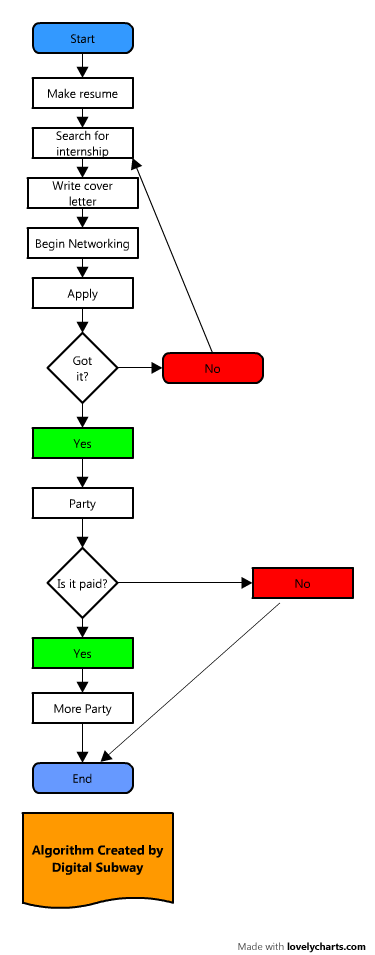
Algorithm for Securing an Internship

I wrote an algorithm for securing an internship. It worked for me and I hope it works for you too.

I created this flowchart and to know more about how this algorithm really works, you will have to become a premium reader of this blog. Calm down. I don't need your credit card number for that. All it means is that you will have to click on the right on Follow button in order to follow my blog and leave a comment so that I can get back to me. 
Good luck.

Tuesday, March 29, 2011

Meeting Engineering Professionals

Networking is the proven way to get hired. Source: http://bit.ly/8up18u
Recently, I have been meeting quite a few professionals from engineering industry. It is mainly because I have more or less decided that I do not want to go graduate school immediately after graduation. Instead, I want to go into workforce and see what work is like, assess what field of work I like the best and then decide about graduate school. Imagine getting a degree in an engineering field such as Electrical, Mechanical or Chemical and not liking the work afterward. You will then be stuck up with that degree for the rest of your life.

In addition, it seems like I will be able to graduate with double degrees. A double degree is different than a double major. You can get a double degree if you major in a Bachelor of Science and also a Bachelor of Arts. In order to get a double degree, you need to have at least 159 credit hours. To give you a sense of what this number means, imagine taking a full load of 18 hours (the maximum allowed at Trinity) every semester for eight semesters. A quick math in your head should tell you that totals 144 hours, still 15 hours short of required 159. You would have to spend an extra semester just to get a double degree. That would be pretty stupid. Furthermore, if you study abroad during your college, you will probably not be able to transfer 18 hours. It could be a maximum of 16 hours. That will increase the deficit further. My solution is: using AP/Advanced Level credits that I received from high school. Still, obtaining a double degree is difficult without attending summer school. I have not and will not be attending summer school but it seems I may just be able to get a double degree if everything works perfectly.

What I intended to get across is that, my interests are diverse and I do not know yet which field I want to focus on for graduate school. A few years in workforce will hopefully give me some insights on what my future path should be.

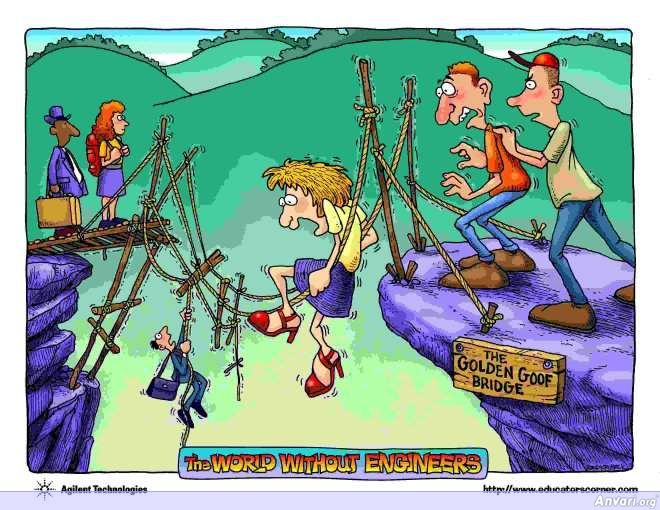
Just a funny cartoon about why Engineering is cool. Source: http://bit.ly/1zsn34
Yesterday, I met civil, petroleum and mechanical engineers working at various companies or as consultants. I was surprised by how many engineers identified themselves as consultants. In order to be a consultant, you need to have an Engineering degree and then get a Professional Engineer license for which you have to have practice in the field for at least two years. They shared lots of stories about their first jobs, what they wish they knew on their first day at the first job and advice to students about how to network or look for a job. One thing I realized from the networking session is that, the proven way of obtaining a job is through networking. It is unlikely that you fill out an application, will get an interview and boom, get hired. It just doesn't happen that way. Instead, you know someone at the company, you send your resume, she forwards it to someone else and testifies how good of a person you are. You then get an interview and likely get selected.
So, lesson learned: start networking and start early.